
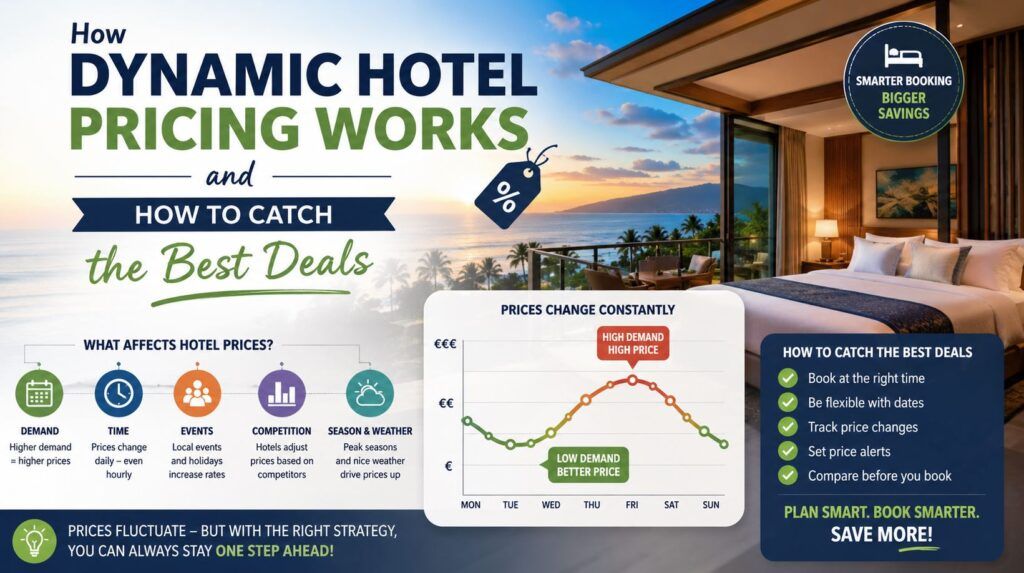
Booking a hotel can feel like a simple transaction: choose a hotel, select your dates, pay the displayed price, and you’re done.
But hotel prices are rarely fixed.
Unlike many physical products, a hotel room is a perishable product. A room that remains unsold tonight cannot be sold tomorrow for the same night. This is why hotels constantly adjust their prices according to demand, availability, booking patterns, seasonality, events, and market conditions.
This practice is known as dynamic hotel pricing — and understanding it can help travelers avoid paying more than necessary.
What Is Dynamic Hotel Pricing?
Dynamic pricing means that a hotel can change the price of a room over time rather than selling every room at one fixed rate.
For example, imagine a hotel has a standard room available for €180 per night. If demand is weak, the hotel might reduce the price to €140 to encourage more bookings.
On the other hand, if a major event is taking place in the city and rooms are selling quickly, the same room could increase to €250, €300, or even more.
The room hasn’t necessarily changed. The price has.
Hotels and revenue-management systems continuously try to answer one fundamental question:
What is the highest price the market is likely to accept for this room on this particular date?
Why Do Hotel Prices Change?
There are several factors that can influence hotel rates.
1. Demand
Demand is one of the biggest drivers of hotel prices.
A hotel may charge substantially more during weekends, holidays, school vacations, major sporting events, concerts, trade fairs, and other periods when many people are looking for accommodation.
When demand falls, prices can move in the opposite direction.
2. Remaining Availability
Hotels have a limited number of rooms.
If only a few rooms remain for a particular date, the hotel may increase prices because the remaining inventory has become more valuable.
Conversely, if many rooms are still available close to the arrival date, the hotel may have an incentive to reduce rates.
3. Booking Window
The number of days between booking and arrival can also affect pricing.
A hotel may price rooms differently six months before arrival than it does two weeks, two days, or even a few hours before check-in.
There is no universal rule that booking earlier is always cheaper. The optimal price depends on the hotel, destination, dates, demand, and current inventory.
4. Competition
Hotels don’t operate in isolation.
Revenue managers can monitor competing properties and the overall market. If similar hotels reduce their prices, a property may need to reconsider its own rates.
This creates a constantly changing competitive environment.
5. Seasonality
A beachfront resort might be significantly more expensive during summer than in the off-season.
A ski resort can experience the opposite pattern, with winter weekends commanding premium rates while prices fall dramatically outside the ski season.
6. Local Events
Concerts, conferences, festivals, sporting events, trade fairs, and public holidays can have a major impact on hotel demand.
A hotel that normally costs €150 per night might suddenly cost €300 or more when thousands of additional visitors arrive in the same city.
The Same Hotel Room Can Have Different Prices
One of the most important things for travelers to understand is that the price of a hotel room is not necessarily constant across booking platforms.
The same property and dates can sometimes be offered at different prices through different online travel agencies (OTAs), direct hotel websites, or other distribution channels.
Research into hotel pricing has documented significant price dispersion across online platforms, meaning that the same or comparable hotel stays can have different prices depending on where they are booked.
This means that finding a hotel isn’t necessarily the end of the search.
Finding the right price matters too.
What Is Hotel Revenue Management?
Behind many hotel prices is a sophisticated discipline called revenue management.
Revenue managers try to optimize a hotel’s income by balancing several variables:
- Room availability
- Expected demand
- Competitor prices
- Historical booking patterns
- Seasonality
- Lead time
- Events
- Cancellation behavior
- Customer segments
- Distribution channels
The objective isn’t simply to have the highest possible room rate.
Instead, the hotel wants to maximize the revenue generated from its available inventory.
For a hotel, an empty room tonight represents lost revenue that can never be recovered. This is why pricing decisions can change rapidly as the arrival date approaches.
Dynamic Pricing Works Both Ways
Travelers often think of dynamic pricing as something that only makes hotels more expensive.
But dynamic pricing can also create opportunities for customers.
Suppose you book a refundable hotel room for €240 per night.
A week later, demand turns out to be lower than expected. The hotel reduces the rate to €190.
You could potentially save €50 per night — but only if you notice the price change.
This is where hotel price monitoring becomes particularly useful.
Why Checking the Price After Booking Matters
Many travelers assume that once they have booked their hotel, the pricing process is finished.
It isn’t.
If your reservation has a free cancellation policy, you may be able to monitor the same hotel and dates after booking.
If the price falls, you can potentially:
- Cancel the original reservation.
- Rebook the same or comparable room at the lower rate.
- Keep the difference.
Of course, travelers should always verify the room type, cancellation policy, taxes, fees, payment conditions, and other booking terms before cancelling an existing reservation.
The biggest challenge is that manually checking hotel prices every day is tedious.
That’s where automated price tracking can help.
Hotel Price Alerts: Let Technology Watch the Price for You
Instead of repeatedly searching Booking.com, Expedia, hotel websites, and other booking platforms, travelers can use a hotel price tracker.
A price tracker automatically checks the price of a selected hotel and travel dates and alerts you when the rate falls.
This turns hotel booking into something closer to a two-stage strategy:
Book a suitable refundable rate first — then keep watching for a better one.
And that’s the idea behind Hotel-Tracker.com.
Hotel-Tracker.com: Monitor Your Hotel Price Automatically
Hotel-Tracker.com is designed to help travelers keep an eye on hotel prices after they have found or booked a stay.
The service can monitor the live rate for your specific hotel and dates and automatically check for changes. According to Hotel-Tracker.com, tracked prices can be checked up to twice a day across booking sites.
If the price drops, you receive an email alert showing the new rate, the potential savings, and a link to book or rebook at the lower price.
That means you don’t have to remember to check the price yourself.
How It Works
Using a hotel price tracker is straightforward:
1. Find your hotel
Enter the hotel and your travel dates.
2. Set your target
You can specify a target price or a minimum percentage saving you would like to see.
3. Let Hotel-Tracker.com monitor the rate
The system automatically checks the relevant hotel price.
4. Receive a deal alert
If the price drops enough to meet your criteria, Hotel-Tracker.com sends you an alert. Optional you can get the daily price of the hotel.
5. Rebook and save
If your existing reservation allows free cancellation and the new offer has comparable conditions, you can cancel and rebook at the lower rate.
Don’t Just Book the Hotel — Watch the Price
The traditional approach to hotel booking is:
Search → Book → Forget
Dynamic pricing suggests a smarter approach:
Search → Book a flexible rate → Monitor → Rebook if the price drops
This doesn’t guarantee that every hotel will become cheaper. Sometimes prices rise continuously, while in other cases they may remain stable.
But if a price drop does occur, monitoring gives you the opportunity to take advantage of it.
The key is flexibility.
A free-cancellation reservation can act as a kind of safety net: you secure your accommodation while retaining the possibility of changing your booking later if a better price becomes available.
Who Can Benefit From Hotel Price Tracking?
Hotel price monitoring isn’t only useful for frequent travelers.It can be particularly valuable for:
Vacation Travelers – If you’re spending thousands on a family holiday, even a €20–€50 reduction per night can add up quickly.
Business Travelers – Companies and frequent business travelers may make many hotel bookings throughout the year. Monitoring rates can create savings across multiple reservations.
Luxury Travelers – When a hotel room costs several hundred euros per night, even a modest percentage reduction can represent significant savings.
Travel Agencies – Travel professionals can monitor clients’ bookings and identify opportunities to reduce accommodation costs or improve margins.
Hotel Managers – Hotel-Tracker.com also offers competitor monitoring for hotel managers, allowing them to watch nearby properties and react to changes in market pricing.
The Future of Hotel Pricing Is Dynamic
Hotel pricing is becoming increasingly data-driven.
Hotels have access to more information than ever before, allowing them to adjust prices according to demand, competition, availability, booking patterns, and market conditions.
For consumers, this creates both a challenge and an opportunity.
The challenge is that the price you see today may not be the price you see tomorrow.
The opportunity is that a price that looks expensive today could potentially become cheaper later.
That is why hotel price monitoring is becoming an important part of smart travel planning.
Instead of assuming that your first booking price is the final price, you can continue watching the market.
Don’t Miss the Next Hotel Price Drop
Dynamic hotel pricing means that your hotel’s price can change even after you’ve made your reservation.
So why keep checking manually?
Hotel-Tracker.com can monitor your hotel price automatically and notify you when the rate drops. Ty now, Silver Membership is FREE!
With a WorldTravelerClub.com Platinum Membership you can get a Premium Gold Membership for free. See more!
Book smart. Keep watching. And if the price falls, be ready to save.